
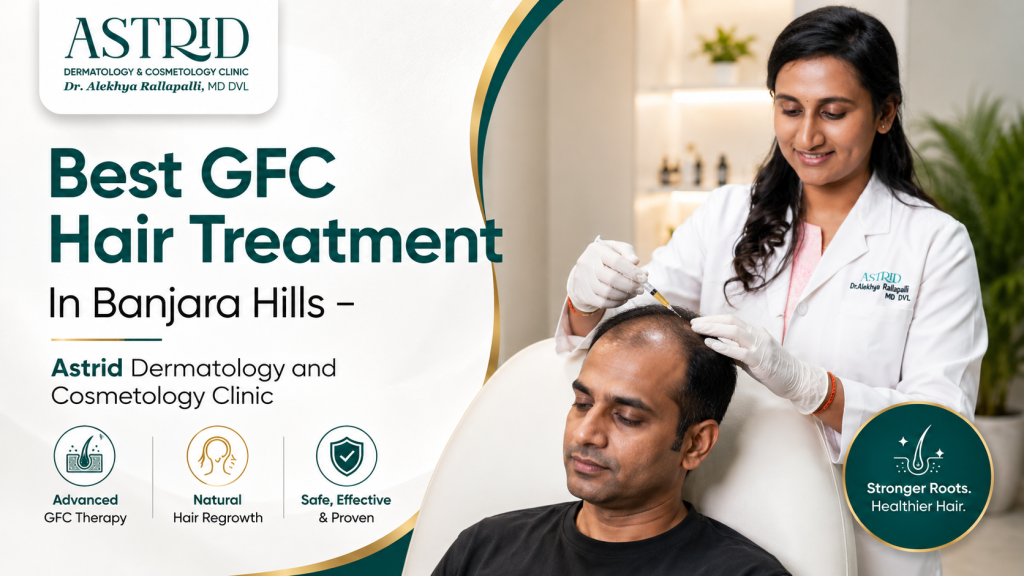
Hardly anyone panics the first time a few extra strands turn up on the pillow. It’s usually the second month, when the parting looks a little wider and the ponytail feels noticeably thinner, that the quiet worry sets in. For anyone sitting in exactly that spot, GFC hair treatment in Banjara Hills has become one of the most talked about ways to get ahead of hair fall before it turns into something far harder to reverse.
At Astrid Dermatology and Cosmetology Clinic, led by Dr. Alekhya Rallapalli, this treatment is helping everyday people slow the shedding, wake up sleepy follicles, and start feeling like themselves again. What follows is the honest, no fluff version of how it works and why it’s worth knowing about.
So, What Exactly Is GFC Hair Treatment?
GFC stands for Growth Factor Concentrate, and the clever part is that the whole thing comes from the patient’s own blood. A small sample gets drawn, much like a routine blood test, then it’s spun and processed with a specialised kit that pulls out the rich, concentrated growth factors hiding inside the platelets. That concentrate is then injected gently into the scalp, right where the follicles need a nudge.
Think of it like delivering fertiliser straight to the roots of a struggling plant instead of just misting the leaves and hoping for the best. Because the material is the body’s own, the GFC therapy is a natural, low risk approach with no synthetic chemicals doing the heavy lifting.
The Growth Factors Doing the Real Work
A few key proteins are responsible for most of the magic:
- PDGF (Platelet Derived Growth Factor): encourages new cell growth and boosts blood supply around the follicle.
- VEGF (Vascular Endothelial Growth Factor): improves circulation so follicles get fed properly.
- EGF (Epidermal Growth Factor): supports follicle repair and keeps the scalp environment healthy.
- IGF-1 (Insulin like Growth Factor): helps existing hair stay in its active growth phase for longer.
Why People Keep Choosing GFC?
Picture someone like Meera, a school teacher in her mid-thirties who had tried every shampoo the internet promised would save her hair. Nothing stuck. When she finally booked a consultation for hair loss treatment in Banjara Hills, what surprised her most was how undramatic the whole thing felt. No surgery, no long recovery, no awkward bandages. Just a short sitting and back to her day.
That low effort, high reward feeling is exactly why the best GFC hair treatment keeps winning people over. Here’s how the main benefits stack up:
| Benefit | What it means for you |
| Natural source | Uses your own blood, so the risk of rejection or reaction stays very low. |
| Minimal downtime | Most people head straight back to work or errands the same day. |
| Less shedding | Slows ongoing hair fall and helps the scalp settle down. |
| Better density | Existing strands grow thicker, and thinning patches start filling in. |
| Fewer sittings | Often needs only three to four sessions to show meaningful change. |
GFC vs PRP: What’s the Difference?
People who’ve researched hair loss usually know about PRP (Platelet Rich Plasma), and a fair question pops up almost every time: aren’t these the same thing?
Not quite. Both start with a blood draw, true. But GFC goes a step further by isolating a purer, more concentrated dose of growth factors, which is why many dermatologists now see it as the more refined upgrade.
| Factor | PRP | GFC |
| Concentration | Standard platelet level | Higher, purer growth factor dose |
| Purity | Contains red and white cells | Mostly clean growth factors |
| Sessions | May need more sittings | Usually three to four |
| Consistency | Varies batch to batch | More standardised result |
What Actually Happens During a GFC Session?
Here’s the thing people fear most, that it’ll be some complicated ordeal. It really isn’t.
A typical growth factor concentrate session runs about forty five minutes and looks like this:
- Quick consultation. The doctor checks scalp health, hair density, and the likely cause of the thinning.
- Blood draw. Around fifteen to sixteen millilitres is taken, the same as a small lab test.
- The sample is activated and spun in a centrifuge to separate out the pure concentrate.
- Using fine needles, the concentrate goes into the thinning zones with very little discomfort.
- Back to life. A bit of mild tenderness may show up, but it settles within a day or two.
What to Expect Afterwards
For a couple of days, it’s smart to skip heavy workouts, harsh styling products, and long stretches in direct sun. Beyond that? Life carries on as normal. Visible change isn’t instant, so patience matters. Most people notice less fall within a few weeks and fuller looking hair across two to three months.
Who’s the Right Fit for GFC Hair Treatment?
This is where honesty counts, because GFC therapy isn’t a miracle for everyone. It shines brightest for people in the earlier stages of hair loss, when follicles are weakening but still alive. Good candidates often include:
- Those noticing early thinning or a widening parting.
- New mums dealing with postpartum hair fall.
- People with mild to moderate pattern hair loss.
- Anyone wanting to strengthen hair after another treatment.
If an area has been completely bald for years, the follicles may no longer respond, and a frank conversation about other options is the kinder path. That’s precisely why a proper assessment beats guessing from a website.
Why Astrid Clinic Is the Name People in Banjara Hills Trust?
Results from any injectable treatment lean heavily on the hands delivering it, and that’s where Dr. Alekhya Rallapalli stands apart. With an MBBS, an MD in Dermatology, Venereology and Leprosy, a fellowship in paediatric dermatology, and well over a decade of experience, she brings a careful, science first eye to every scalp she treats.
Patients often mention the same things: she explains what’s realistic instead of overpromising, she keeps the sessions gentle and comfortable, and she actually listens. The clinic sits on Road Number 2 in Banjara Hills, just opposite KBR Park, with modern equipment and a calm, welcoming feel. For anyone weighing up the best GFC hair treatment in Banjara Hills, that blend of expertise and warmth is hard to beat.
Frequently Asked Questions (FAQs) About GFC Treatment
1. Is GFC hair treatment painful?
Most people describe it as mildly uncomfortable rather than painful. The needles are fine, the session is short, and a numbing option can be discussed beforehand to keep things easy.
2. How many GFC sessions are needed to see results?
As a rule of thumb, three to four sittings spaced a few weeks apart give the best outcome, though the exact plan depends on the degree of hair fall and the response to each session.
3. How is GFC different from PRP for hair loss?
Both use the patient’s own blood, but GFC delivers a purer and more concentrated dose of growth factors, which often means cleaner, more consistent results in fewer visits.
4. Is GFC hair treatment in Banjara Hills safe?
Because it relies on your own blood, the GFC hair treatment carries a very low risk of allergy or rejection. When done by an experienced dermatologist like Dr. Alekhya Rallapalli, safety stays a top priority.
5. When will results from GFC therapy become visible?
Reduced shedding can appear within a few weeks, while visible density and thickness usually build up over two to three months as the follicles respond to the growth factor concentrate.
A Fuller Head of Hair Starts With One Honest Conversation
Hair loss rarely fixes itself, and the longer it’s ignored, the fewer options tend to remain. The encouraging news is that catching it early changes everything, and GFC hair treatment in Banjara Hills offers a natural, gentle way to do exactly that. If thinning has been quietly chipping away at your confidence, there’s no need to keep guessing.
Book a consultation today with Astrid Dermatology and Cosmetology Clinic and let Dr. Alekhya Rallapalli help your hair, and your confidence, grow back stronger.